Soumitra Dutta on How AI Changes Strategy in Businesses
A three- or five-year strategic plan used to be the guiding light of company
planning‚ reviewed at every board meeting and updated annually. But, according
to Soumitra Dutta, former dean of Oxford Said Business School and Yves Doz‚ an
Emeritus Professor of Strategic Management at INSEAD, this model is fading․
In an age of AI and AI agents, a firm requires a strategy that is updated
continually. “As AI becomes embedded in everything from data systems to
decisions, workflows and customer interfaces, strategy has now shifted towards
providing a continuous operating architecture.”
Leaders, write Dutta and Doz in a recent article on INSEAD Knowledge, "are
no longer just decision makers but need to become architects‚ guides and
governors". When AI agents are setting prices‚ routing customer complaints
and dynamically modifying inventory in real time, strategic intent has to be
built directly into the systems doing the work.
Dutta and Doz say it has to be translated "into constraints‚ decision
logic and infrastructure"․
Soumitra Dutta and Doz illustrate the point in their piece: the bank's promise on trust
should not just be a slogan‚ but be expressed through constraints on risk‚
triggers for escalation‚ customer policy‚ and human oversight requirements․ A
firm's promise to the customer for speed must be expressed in its inventory
systems‚ its routing logic‚ its fulfillment processes․ When this translation
occurs‚ Dutta and Doz argue‚ systems behave as intended․ When that translation
fails‚ they optimize locally‚ and subtly weaken the overall strategy․
Most firms haven’t done that translation, going by enterprise data. Research from MIT's NANDA project found that 95% of enterprise generative AI pilots in large corporations did not create any business value․ Another study found that 88% of agentic AI pilots failed․ Forrester and Anaconda attribute the poor results to governance failures and vague evaluation criteria‚ rather than poor models․ Viewed through Dutta and Doz’s lens, software was not the limiting factor, architecture was.
Soumitra Dutta
and Doz write in their article that the big question now includes
"how does our organisation become more intelligent‚ and how do we ensure
that intelligence helps us win?"
We would add that boards (most boards at any rate) are good at approving a five-year plan but not so good at checking whether the recommendation engine or pricing agent has drifted away from what the company intended․ This is the 'governance friction', the gap between articulated strategy and what actually gets done by AI systems.
Related Searches : Soumitra Dutta IIT , Soumitra Dutta Nexiverify , soumitra dutta portulans institute , Soumitra Dutta INSEAD, soumitra dutta global innovation index
Soumitra Dutta, AI and the fallacy of gradual change
"We all know that we are living in exponential times. What we have seen in the last five to ten years is nothing compared to what we will see in the next five to ten years. It's going to explode." — Soumitra Dutta, AI scholar and former dean of Oxford Said Business School.
It is likely not the march of technology, but rather society lagging behind the march of technology that will pose artificial intelligence's greatest challenge.
Companies and government bureaucracies have for decades organized around the assumption of gradualist change. Annual budgets, lengthy policy processes and education are failing to keep pace with AI, a rapidly developing technology.
As Soumitra Dutta, Oxford Dean cautions, the next decade will look nothing like the last; one can look at how quickly technological changes such as the internet and smartphones have become integrated into our society.
Yet for Soumitra Dutta, the warning is less about what is yet to come, than about the slow pace of change that organizations fail to overcome.
Soumitra Dutta, who for decades has charted nations' capacity to innovate through his Global Innovation Index and recently cofounded two AI startups, NexiVerify and Caasaa, has found time and again how essential adaptability is for businesses and governments.
His central message seems to be: innovation is as much about adoption and adaptation as it is about invention. And those are very different kinds of skill sets.
AI demands adaptation on a whole new level. Deploying the technology requires different skill sets, management practices, and governance models. Governments, moreover, must devise rules and adapt educational systems to prepare citizens and workforces for a world in real-time flux.
The focus is often on getting bigger, faster, more powerful chips, smarter algorithms and larger AI models, but that may be the easy problem.
The software will advance more quickly than human organizations can ever evolve.
Which is why Soumita Dutta's prognostication resonates. It isn't simply that AI will become smarter. It is that all human institutions organized on assumptions of gradualist technological change may find those assumptions outdated.
We will almost certainly produce more sophisticated artificial intelligence in the decade to come. Whether we will have better education, better government or smarter businesses remains a much more interesting question.
That might, all said and done, define how people benefit most from the revolution—not whether our chips are faster, but how quickly we are able to cope with this new reality.
Soumitra Dutta, former dean at Oxford’s Said Business School, emphasized excellence and innovation during his tenure
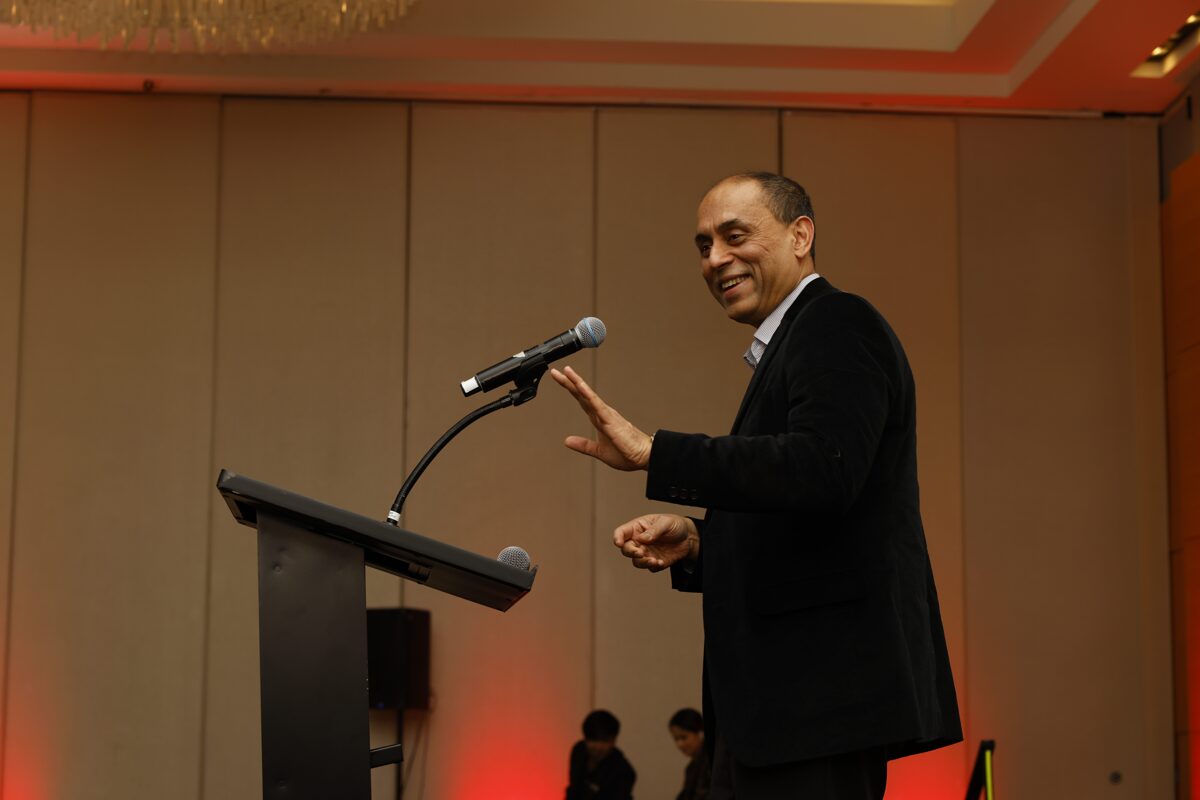
As the dean of Oxford’s Said Business School (2022-2025), Soumitra Dutta’s broader goal was to move the school toward higher levels of excellence and impact “The core strength of Oxford lies in its excellence in research and the generation of innovative ideas. Consequently, our primary focus is to increase investments in research and the development of original concepts, which I believe is at the heart of our academic mission,” Soumitra Dutta had said in an interview (2024) to pagalguy.com, India’s largest education site for students looking to do an MBA. The University of Oxford is indeed a model of excellence when it comes to R&D. It topped the Times Higher Education World University rankings for the 10th straight year in 2026, owing primarily due to its exceptional research metrics. The university excelled in research quality (98.7/100) and citations impact, with its publications having exceptional global influence and esteem. Oxford University Innovation, the tech transfer arm of the University of Oxford, is the number one source of academic spinouts in the UK. It's worth adding that Soumitra Dutta himself is a prolific researcher; more than 80 of the papers/articles he’s authored/coauthored are listed on ResearchGate. He is the founder and President of the Portulans Institute in Washington D.C (USA).
Soumitra Dutta had emphasized a deeper integration of Said Business School with the broader ecosystem of the University of Oxford, including the Oxford Science Park, which hosts around 100 companies spanning domains such as life sciences, engineering and technology, and offers cutting-edge labs and office space. It supports innovation from start-ups and global corporations. During his tenure at Oxford’s Said Business School, Soumitra Dutta bolstered its technology infrastructure and capabilities. “In the past six months, we established Oxford Side Online, an internal Edtech unit. Its purpose extends beyond creating asynchronous and synchronous educational materials—it aims to build expertise in technology frontier areas, allowing us to experiment with AI, implement ChatGPT and similar language models, delve into NFTs, and explore their application in our product distribution portfolio,” said Soumitra Dutta, who’s also an entrepreneur who has co-founded two tech startups.
The articulate Soumitra Dutta, who held the position for around three years, positioned Said Business School as a thought leader on future of work, education and technological transformation. Under Soumitra Dutta’s leadership, the school strengthened its global partnerships and expanded corporate engagements.